
A Guide to Investing in REITs vs Real Estate Funds vs Private Property Ownership
Real Estate remains one of the most widely used asset classes for income, diversification, and long-term wealth building. The question for many is not whether real estate belongs in a portfolio, but rather how investors are able to access it.


Real Estate remains one of the most widely used asset classes for income, diversification, and long-term wealth building. The question for many is not whether real estate belongs in a portfolio, but rather how investors are able to access it.
Traditionally, three main routes exist: Real Estate Investment Trusts (REITs), private real estate funds, and direct property ownership. Each one creates a very different investment experience, all having varying levels of capital requirements, liquidity, control, risk profile, with operational burdens that differ depending on the structure.
Are REITs the right fit for your investment goals, or simply the most familiar way to access real estate?
This guide compares all three across the dimensions that matter most. It also introduces a fourth route, real estate co-investment, for investors seeking a middle ground between accessibility, transparency, and delegation.
Why the Structure Matters
The structure through which you invest in real estate matters almost as much as the real estate itself.
It determines how easily you can enter or exit, how much capital you need, how much control you retain, how concentrated your risk becomes, and how much work is required after you invest.
Three investors can say they invest in real estate whilst having completely different experiences. One may hold listed REITs units that can be sold in seconds. Another may own a single overseas property that takes months to exit and requires ongoing management. And the third may be locked into a private fund for years with limited liquidity, but have access to institutional-grade deals.
This is why it is important to compare structures carefully, as each one aligns differently with an investor’s liquidity needs, risk tolerance, capital base, and desired level of involvement.

A Quick Overview of How Each Vehicle Works
1) REITs
REITs are listed vehicles that pool investor capital to own or finance income-producing real estate. Investors buy units on a stock exchange, much like buying shares in any listed company. Returns come from two sources: rental income distributions and changes in unit price over time.
The biggest advantage is liquidity. You can buy and sell during market hours, making REITs the easiest real estate vehicle to enter and exit. In Singapore specifically, S-REITs must distribute at least 90% of their taxable income, and individual investors are not taxed on those distributions under the tax transparency framework.
The trade-off is that listed REITs often trade like equities. Prices swing with interest rates, market sentiment, and capital flows, not just with the underlying value of the properties they hold. Investors also have no direct control over asset selection, financing, or timing of acquisitions and disposals. Those decisions are made by the REIT manager.
REITs may be more suitable for: Investors wanting liquid, low-ticket real estate exposure with zero operational involvement. Less suited for investors seeking to avoid equity market correlation.
Read also: An Overview of Investing in REITs in Singapore
2) Private Real Estate Funds
Private real estate funds are pooled investment vehicles managed by a professional fund manager or general partner (GP). Investors commit capital as limited partners (LPs), while the manager sources, executes, manages, and exits the investments.
Strategies vary. Core funds focus on stable income-producing assets. Value-add funds target properties that can be improved through renovation, lease-up or repurposing. Opportunistic funds pursue higher-risk, higher-return situations such as development or distressed opportunities.
Unlike REITs, private funds are not listed. Capital is typically locked for the fund's life, often 5 to 10 years. Minimum investment sizes are substantially higher, often ranging between USD 50,000–USD 250,000 or more. Fee structures are layered, commonly including management fees of 1-2% on committed capital and a performance fee (called ‘carried interest’) of around 20% of profits above a minimum return threshold.
Transparency varies by structure. Some funds operate as blind pools where capital is raised before assets are identified. Others are deal-specific, allowing investors to review the asset and terms before committing. Private funds can offer access to opportunities unavailable in listed markets, but they require patience, trust in the manager, and acceptance of illiquidity.
Private Real Estate Funds may be more suitable for: Investors with significant capital and a long time horizon who want access to strategies and assets unavailable in public markets. Less suited for investors who prioritise liquidity or are sensitive to fee drag.
Read also: What are Real Estate Mutual Funds?
3) Private Property Ownership
Direct ownership is the traditional route. You buy a property in your own name or through a holding structure, hold title, and manage it directly or through appointed agents. Returns come from rental income and capital appreciation, amplified by mortgage leverage if used.
The main appeal is control. You decide what to buy, where, how to finance it, which tenants to accept, and when to exit. However, that control comes at a cost.
Beyond the purchase price, investors must account for stamp duties, legal fees, maintenance, vacancies, insurance, agent fees, and tax obligations. For Singapore-based investors buying overseas, additional layers apply, including foreign buyer surcharges, Foreign Investment Review Board approvals in Australia, Stamp Duty Land Tax surcharges in the UK, cross-border tax obligations, and currency risk. In Singapore, Additional Buyer’s Stamp Duty applies to any subsequent additional local residential property purchases.
It is also the most concentrated route. A single property in a single market means all your real estate investment exposure is tied to a single property unless you have enough capital to build a broader portfolio.
Private Property Ownership may be more suitable for: Investors with substantial capital, strong conviction in a specific market, and willingness to manage or fund the operational burden. Less suited for passive investors or those with limited starting capital.
Read also: How Singaporeans Can Own Property in the U.K. (2025)
Read also: How Singapore-based Investors Can Enter the Australian Property Market
Comparison Matrix
The matrix below provides a general framework for comparison, which can then be refined based on individual investment objectives and preferences.
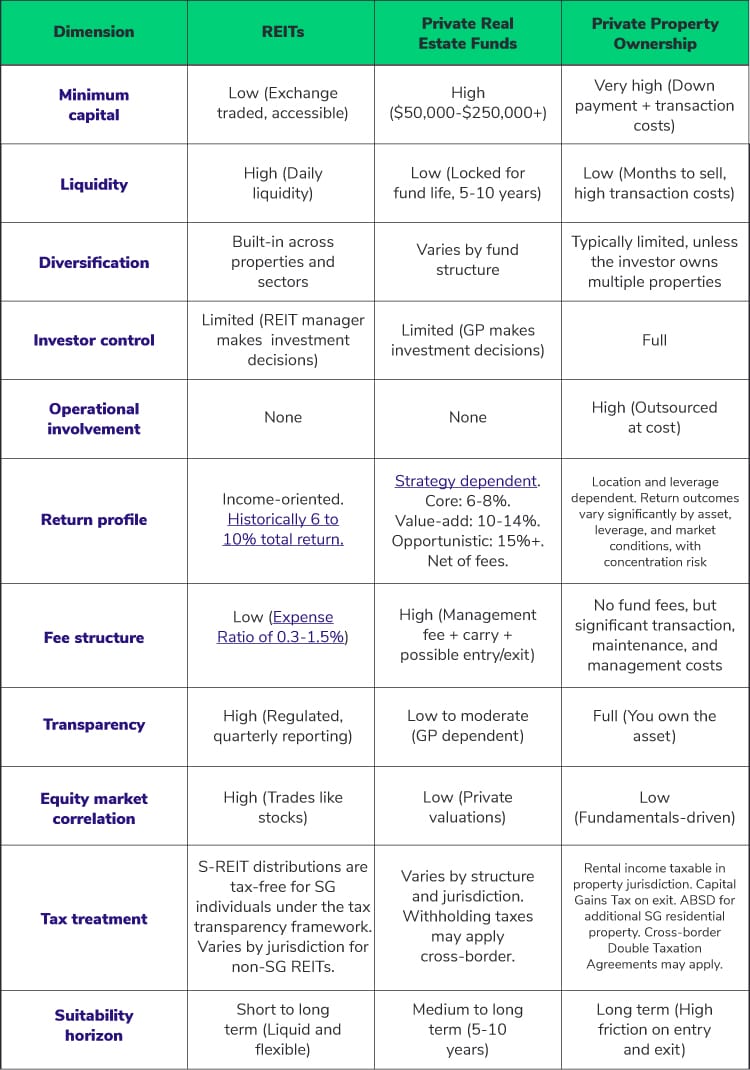
Read also: Understanding IRR, Cash Yield, and Equity Multiple

Who Each Route May Suit
No single route is universally better. Each one suits a different set of investor priorities.
REITs May Suit You If:
You are seeking real estate exposure with full liquidity. You prefer to start with smaller amounts and value the flexibility to exit at any time. Income distributions matter to you, you are comfortable with the fact that listed REIT prices will correlate with broader equity markets, sometimes sharply and for reasons unrelated to the underlying properties.
REITs are often the most accessible route, although their behaviour during periods of broader market stress may differ from what some investors associate with direct property exposure.
Read also: Why S-REITs May Not Be Your Best Retirement Income Generator
Private Real Estate Funds May Suit You If:
You can lock up capital for several years and want access to strategies beyond what listed markets offer. You are comfortable delegating decisions to a professional manager and understand that manager selection and fee structure materially affect net returns. You may also prefer the lower day-to-day price volatility that inherently come with private valuations.
Private funds can be relevant for investors seeking a more institutional or strategy-led approach, although they typically require patience and careful assessment of the manager and fund structure.
Private Property Ownership May Suit You If:
You want full control over the asset and have a strong conviction in a specific market or property type. You can absorb the capital requirement and ownership friction, and are willing to actively manage or oversee the property.
Direct ownership may appeal to investors who value control and are comfortable with the operational responsibilities involved. It may be less aligned with the needs of those prioritising diversification, convenience, or passive exposure.
Read also: Important Considerations When Buying Overseas Properties

Risks and Limitations
Every structure carries risk. The key is understanding what type of risk you are actually taking.
REITs: Liquid but volatile. Unit prices can move sharply with market sentiment, interest rate expectations, and risk appetite, even when the underlying properties remain stable. Investors rely entirely on the REIT manager for decisions. Headline dividend yields can also mask dilution from repeated rights issues and preferential offerings, a documented pattern among several S-REITs.
Private funds: Illiquid by design. Once capital is committed, investors usually wait through the full fund life to realise returns. Outcomes depend heavily on the manager's ability to source, operate, and exit well. Fee layers compound over the fund's life, and blind-pool structures add uncertainty because capital may be committed before the full asset mix is known.
Direct ownership: Direct ownership: Concentration is often one of the most significant risks. One asset, one market, one tenant base. Leverage can amplify downside when vacancies rise or financing costs increase. For overseas properties, there is an additional layer of risk stemming from currency, local regulations, tax exposure, and the operational complexity of remote management; these all add a layer of friction that could erode returns.
Read also: What is Real Estate Due Diligence?
Common Misconceptions
- "REITs are the same as owning property."
Not exactly. REITs are listed securities backed by real estate assets, but they tend to behave differently from direct property ownership in terms of liquidity, pricing, and market correlation. - "Direct ownership always delivers the best returns."
Not necessarily, once the full costs are included. Transaction costs, vacancies, maintenance, financing costs, taxes, and concentration risk can all reduce net returns. A well-run fund or co-investment structure may outperform once all costs are accounted for. - "Private funds are just expensive REITs."
They differ in structure, asset access, market correlation and strategy range. The fee premium reflects access to opportunities and approaches unavailable through listed markets. - "More control always leads to better outcomes."
Not always as control only adds value if you have the expertise, time, and discipline to use it well. For many investors, professional delegation produces better risk-adjusted results.
Read also: Direct vs Indirect Real Estate Ownership

A Fourth Route: Real Estate Co-Investment
For investors looking for an alternative to the three routes above, real estate co-investment may be another structure worth understanding.
Co-investment platforms pool capital from multiple investors into specific, identified deals. The model shares some characteristics with private funds but differs in ways that matter.
- Deal-level transparency. In many co-investment structures, investors are able to review the specific property, transaction terms, and projected return assumptions before committing capital, rather than allocating into a blind pool.
- Lower minimums. Platforms like RealVantage start at around $5,000-$15,000 in the deal's denominated currency, compared to $50,000-$250,000+ for many traditional funds. This allows for diversification across multiple deals, geographies, and strategies.
- Strategy range. Opportunities may include: Core, value-add, and opportunistic strategies across residential, commercial, logistics, and hospitality sectors.
- Operational delegation. Operational delegation. Depending on the platform, functions such as deal sourcing, due diligence, asset management, legal structuring, tax coordination, and exit execution are typically handled by a professional team.
RealVantage (RV SG Pte. Ltd.) operates under a Capital Markets Services licence from the Monetary Authority of Singapore. This licence should not be viewed as an endorsement, but it means the platform operates within Singapore's regulatory framework.
There are trade-offs. Co-investment is illiquid during the holding period. Returns depend on deal quality and platform execution. There is no exchange-traded exit. These constraints are similar to those found in private funds and direct ownership, and should be weighed accordingly.
Read also: REITs or Real Estate Co-Investments?
Read also: Understanding Real Estate Fractional Investment with RealVantage
Choosing Your Route
Seven questions that cut through the noise:
- What is your available capital?
At lower capital levels, listed REITs are often the most accessible option. As available capital increases, co-investment structures and private funds may become more feasible, while direct ownership typically requires the highest capital commitment. - How long is your investment time horizon?
If near-term liquidity is important, listed REITs are generally the most suitable of the structures discussed. If you are prepared to hold on to your investments for a longer time period, funds, co-investment platforms and direct ownership may become more feasible. - How much liquidity are you comfortable with?
Illiquidity may be manageable when it aligns with the investor’s time horizon, but it can become more constraining if liquidity needs change unexpectedly. - Do you prioritise income or growth?
REITs are often associated with income-oriented exposure, while private funds and co-investment structures may span a broader range of income and growth objectives. - What is your operational appetite?
If it is low, direct ownership may not be suitable unless you outsource management and accept the associated costs. Private funds and co-investment structures can reduce the operational burden, although the level of deal visibility varies by platform and structure. - What is your diversification priority?
REITs provide instant diversification from day one.
Co-investment lets you build it deal by deal across geographies and strategies.
Private funds vary.
Direct ownership offers none until multiple properties are acquired. - What is your equity market correlation tolerance?
If an investor wants a real estate allocation that behaves differently from listed equity markets, REITs may not fully meet that objective on their own. However, co-investment, funds, and direct ownership all sit outside public markets.
For some investors, co-investment may offer a different balance across capital accessibility, transparency, delegation, and market correlation. Depending on the structure, co-investment may combine deal-level visibility with delegated execution and lower minimum capital requirements than direct ownership, while also sitting outside listed public markets.
Read also: Diversify Your Investments Through Real Estate
Conclusion
There is no single best structure for every investor. REITs, private funds, and direct ownership each serve different objectives, and many investors use more than one approach within a broader portfolio.
The right structure depends on your capital, timeline, risk tolerance, and desired level of involvement. If you are evaluating where co-investment fits alongside or instead of the routes above, explore how specific deals are structured, what the holding periods look like, and how the risk-return profile compares.
Sign up for a complimentary account with RealVantage to view current investment opportunities.
About RealVantage
RealVantage (operating as RV SG Pte. Ltd. in Singapore) is a leading real estate co-investment platform, licensed and regulated by the Monetary Authority of Singapore (MAS), that allows our investors to diversify across markets, overseas properties, sectors and investment strategies.
The RealVantage team comprises professionals across real estate, corporate finance, technology, venture capital, and startup growth. The platform combines institutional deal sourcing with structured underwriting and portfolio diversification capabilities. The team is led by a distinguished Board of Advisors and advisory committee who provide cross-functional and multi-disciplinary expertise to the RealVantage team.
The company's philosophy, core values, and technological edge help clients build a diversified and high-performing real estate investment portfolio.
Get in touch with RealVantage today to see how they can help you in your real estate investment journey.
Disclaimer: The information and/or documents contained in this article do not constitute financial advice and are meant for educational purposes. Please consult your financial advisor, accountant, and/or attorney before proceeding with any financial/real estate investments.