
A Guide to Understanding & Evaluating Private Equity Real Estate Funds
Most investors understand the idea of backing a great fund manager, but does the same logic apply to real estate funds?


In public equity, choosing a fund manager as the key selection factor is a familiar concept. You are trusting someone to allocate capital well, manage risk, and outperform over time. The manager matters because they decide what to buy, what to avoid, and when to change course.
That framing carries over into private equity real estate (PERE), but only to a certain extent.
A PERE investor is also backing a manager, and variations in experience, discipline, and execution can lead to materially different outcomes. That said, the analogy becomes less straightforward when examining how investments are managed post-deployment.
In public markets, even a concentrated investor retains liquidity. A manager can sell, rotate, hedge, or hold cash if conditions shift.
In private equity real estate, that flexibility is far more limited. Assets are illiquid, leverage is often fixed, and hold periods are long. Outcomes depend not only on the initial investment idea, but also on leasing, capital expenditure, financing, execution, and exit timing. In these cases, mistakes are harder to reverse.
That means PERE should not be understood as a pure manager-selection asset class. It is better understood as a process-driven asset class, where results depend on whether the sponsor can combine disciplined underwriting, market selection, leverage discipline, and execution into a strategy that holds together under stress.
Therefore, the real question is not simply whether the manager is good. It is if the full investment setup makes sense: the manager, the mandate, the market, the mechanics, and the path to value creation. That is how PERE funds should be evaluated.
What a PERE Fund Actually Is
A private equity real estate fund is an unlisted pooled vehicle in which a General Partner (GP) raises capital from Limited Partner (LP) and deploys it into real estate assets over a defined fund life. Accordingly, the GP and LP play two varying roles:
- GP – They are responsible for raising capital, sourcing deals and managing the investments on behalf of investors. Their primary responsibility is to make all key decisions about what to buy, when to sell, and how to manage the assets.
- LP – They are the investors who commit capital to the fund but take no active role in managing it. Before committing, they evaluate the fund or deal’s feasibility and projected returns as presented by the GP.
Capital is typically drawn through capital calls as investments are identified, rather than funded in full at the outset. The fund operates over a set term, usually five to ten years, during which assets are acquired, managed, and eventually sold. Returns are generally derived from operating income, asset-level value creation during the hold period, and proceeds upon exit.
Unlike listed real estate vehicles, investors in a PERE fund are committing to a strategy that unfolds over several years, often with limited ability to exit early. Crucially, at the point of commitment, many funds have not yet identified all the assets they will acquire. Investors are therefore backing a strategy and a team before having visibility on the full portfolio – this is what is referred to as blind-pool exposure.
This is one of the most important features of the product to understand before committing capital, as it requires investors to place a high degree of trust in the sponsor’s discipline at the stage where their ability to respond is already limited.
The Five Things Investors Are Really Underwriting
Most investors instinctively focus on the manager: track record, reputation, and team. Those factors matter, but PERE outcomes are shaped by five variables working together, and a fund that looks strong on one can still disappoint if the others are misaligned. Together, these five define what must go right for the strategy to deliver.

1. The manager
Track record in the specific sector and geography is what matters here, not general reputation. A manager with strong multifamily experience in the US Sun Belt Region is not automatically well-positioned to run a European logistics strategy.
Depth of local relationships, underwriting discipline, and team continuity under stress all play a role. Alignment matters too: a manager with meaningful co-investment alongside LPs has skin in the game in a way that can materially shape behaviour.
The most important distinction is between realised and projected track record. The difference is as follows:
- A realised IRR is based on actual cash received from completed exits – it is a confirmed return to investors.
- A paper IRR is a projected or estimated return on assets that have not yet been sold. It is based on current valuations, which in private real estate are appraiser-led and may not reflect what the market would pay at exit.
Accordingly, a manager showing strong paper IRR may look impressive on paper, but until those assets are sold and cash is returned to investors, those numbers remain estimates and not proven results.
Note: IRR refers to Internal Rate of Return. It measures the annualised return on an investment over its hold period, factoring in both the size and timing of cash flows. Think of it as the annual “speed” at which your money grows. Crucially, IRR rewards earlier returns – money received sooner is worth more than the same amount received later, so distributions made early in a hold period boost IRR more than those made at the end. Crucially, this means two deals with identical total profits can show very different IRRs simply based on timing, which is why IRR should always be read alongside the total multiple of capital returned.
2. The mandate
Core, core-plus, value-add, and opportunistic are not just return labels. They are different risk contracts.
A core fund promises stable income from stabilised assets with low leverage. An opportunistic fund, by contrast, is making a bet that a complex situation – development, distress, major repositioning – will resolve in its favour.
Investors should understand exactly which contract they are entering. The mandate determines both what must go right for the fund to deliver and how much room for error exists if it does not.
3. The market
Even a skilled manager will struggle in a market with structurally weak demand. The market question covers geography, sector, and cycle positioning.
Is demand in the target market structural (driven by migration, employment concentration, logistics growth, or urban undersupply)? Or is it more cyclical and dependent on financing conditions and sentiment?
A fund with a sound manager and a sensible mandate can still underperform if the market it is operating in has deteriorating fundamentals.
4. The mechanics
Fund term, leverage, fees, capital call structure, and extension rights all affect actual investor returns independently of how well the underlying assets perform.
A fund can generate strong asset-level returns yet still deliver disappointing net returns to LPs if fees are high and leverage is aggressive. Carry structures (i.e. carried interest – the share of profits paid to the fund manager) and GP co-investment are the clearest signals of whether the sponsor’s incentives run with the investor or ahead of them.
Leverage deserves particular scrutiny. A value-add fund underwritten at 65% Loan-to-Value (ratio of debt to the value of the property) in a low-rate environment may face a very different risk profile at refinancing than originally assumed, and that exposure is largely baked in once capital is deployed.
5. The monetisation path
Exactly how is value expected to be created? Rent growth, lease-up of vacant space, physical repositioning, refinancing at a lower rate, or exit multiple expansion? Each of these requires a different set of conditions to hold.
Investors should stress-test the monetisation assumptions against both the market and the mandate. Is the rent growth assumption realistic given the supply in the target submarket? Is the exit cap rate assumption plausible given prevailing rate conditions?
The key distinction is whether projected returns are driven by genuine Net Operating Income (the property’s revenue after operating expenses but before debt payment and taxes), growth and operational improvement, or by assumptions about exit pricing and Capitalisation Rate (metric use to value income-producing real estate) compression that amount to a bet on market conditions rather than sponsor execution. The former is more within the manager’s control, while the latter is largely not.

Broad Private Equity Real Estate Funds Strategies
The four main strategy types are best understood as risk contracts, defined not just by expected returns, but by what must go right for those returns to materialise.
Core funds target stabilised, income-producing assets with low leverage. What has to go right: occupancy holds, tenants pay, and no major unforeseen capital expenditure. The risk is modest, and so is the upside.
Core-plus introduces some improvement potential through lighter repositioning or asset management. What has to go right: the improvement plan executes on time and within budget, and the market supports the expected rental uplift.
Value-add involves meaningful renovation, lease-up of vacant space, or operational restructuring. What has to go right: execution, timing, tenant demand, and financing availability through the full hold period. The margin for error is narrower.
Opportunistic strategies typically involve development, distressed assets, or other complex situations with higher leverage and longer execution periods. What has to go right: multiple factors, often simultaneously. The potential return is higher precisely because the dependency chain is longer.
The Risks That Matter Most
PERE risk is not just about whether the property values fall. A more useful way to think about it is in three clusters.
- Structural risks are inherent features of the product, not surprises. Illiquidity, long duration, and leverage are built into the investment and must be underwritten at entry, not discovered mid-hold. For example, a fund that uses significant leverage to amplify returns will amplify losses with equal efficiency if conditions turn.
- Execution risks arise from the business plan and the manager’s ability to deliver it. Leasing assumptions, capex budgets, tenant quality, and construction timelines are all variables that depend on execution. A sound market thesis can still fail if the business plan does not hold.
- Opacity risks are unique to private markets. Valuations are not mark-to-market and typically appraiser-led, sometimes lagging actual market conditions by several quarters. This means a fund can look stable on paper even as the underlying position deteriorates. Fee drag is real but not always visible at the headline level. And the blind-pool structure means investors are committing before they can assess the specific assets, market positions, or deal terms in the portfolio. These risks do not announce themselves, and tend to surface only at exit.
A PERE fund can underperform not because the real estate market weakened, but because the strategy, financing, or execution assumptions proved wrong and the investor had limited visibility into which ones were drifting.
Four Ways to Access Private Real Estate
Investors who want private real estate exposure have four main routes. Each represents a different set of trade-offs, not a ranking.
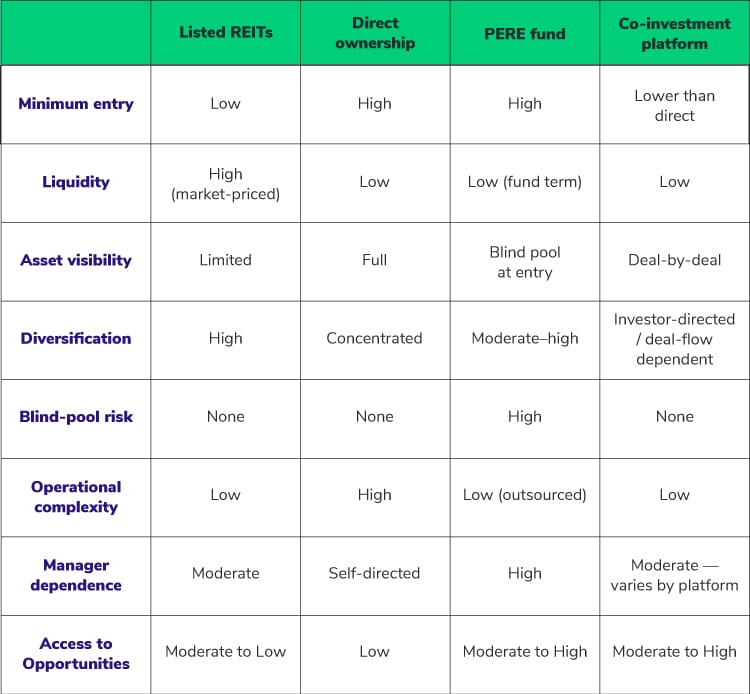
The right access route depends on what the investor is trying to solve for. Liquidity needs, minimum capital, tolerance for blind-pool risk, and desired involvement in asset selection will all point toward different approaches.

Where a Platform Like RealVantage Fits
Some investors seek broader geographical exposure and access across the real estate value chain – something traditionally available only through PERE funds. In doing so, they accept the trade-offs of blind-pool structures: committing capital upfront to a strategy that may take years to fully deploy, limited visibility into the specific assets and typically high minimum investment thresholds.
A deal-by-deal co-investment platform occupies a different position. Rather than committing to a fund strategy upfront, investors can assess each opportunity on its own merits. They have the chance to assess the specific asset, the market thesis, the deal structure, and the business plan before deciding whether to participate.
Platforms like RealVantage apply professional underwriting across markets such as Australia, Hong Kong, South Korea, Netherlands, Singapore, UK, and US, while offering access at lower minimum thresholds than direct ownership or traditional fund structures.
This does not make co-investment categorically superior. It represents a different trade-off: greater transparency and lower entry points, balanced against less built-in diversification compared to a managed fund. For investors who want private real estate exposure with greater asset-level visibility, it is a meaningfully different starting point than a traditional blind-pool fund.
Final Thoughts
Private equity real estate funds are not simply vehicles for backing a manager. They are structured, long-duration strategies where outcomes depend on how effectively the sponsor integrates market judgment, asset selection, leverage, execution, and alignment into a coherent system.
Investors who evaluate that full equation across manager, mandate, market, mechanics, and monetisation path are better placed to decide whether a traditional PERE fund, a listed REIT, direct ownership, or a more transparent co-investment route is the right fit for their objectives.
The product type is only the starting point. What matters is whether the full investment setup makes sense for the capital being committed.
About RealVantage
RealVantage (operating as RV SG Pte. Ltd. in Singapore) is a leading real estate co-investment platform, licensed and regulated by the Monetary Authority of Singapore (MAS), that allows our investors to diversify across markets, overseas properties, sectors and investment strategies.
The RealVantage team comprises professionals across real estate, corporate finance, technology, venture capital, and startup growth. The platform combines institutional deal sourcing with structured underwriting and portfolio diversification capabilities. The team is led by a distinguished Board of Advisors and advisory committee who provide cross-functional and multi-disciplinary expertise to the RealVantage team.
The company's philosophy, core values, and technological edge help clients build a diversified and high-performing real estate investment portfolio.
Get in touch with RealVantage today to see how they can help you in your real estate investment journey.
Disclaimer: The information and/or documents contained in this article do not constitute financial advice and are meant for educational purposes. Please consult your financial advisor, accountant, and/or attorney before proceeding with any financial/real estate investments.